Japandi interior design in Singapore: how to do it in an HDB, condo or landed home
The quick answer
Japandi mixes Japanese restraint with Scandinavian warmth: pale timber, soft neutrals, low furniture and hidden storage. It suits Singapore HDB flats well because it makes small rooms feel calm, but only if storage is planned properly and the timber is chosen for humidity. Budget follows your flat type and scope, not the style itself.
Key points
- The look rests on three things: one main timber tone, a narrow warm palette, and almost nothing on show.
- In an HDB, hide the aircon trunking and the shelter door, or the calm breaks.
- Choose engineered wood or good vinyl over solid timber floors in our humidity.
- Japandi has no price of its own. A 4-room BTO renovation is estimated at $50,000 to $60,000 in 2026 (Qanvast); veneer instead of laminate raises carpentry cost.
- The fastest way to make it generic: too many shades of wood and too much open shelving.
What is Japandi, and where does it come from?
Japandi blends Japanese and Scandinavian design. The two traditions influenced each other long before the word existed: the Danish Architecture Center notes that Japonisme reached Denmark partly through the ceramicist Arnold Krog, and that the term "Japandi" itself first appeared in the mid-2010s.
As designers, we read it this way: the Japanese side brings low lines, quiet surfaces and respect for natural material. The Scandinavian side brings comfort: softer timber, textiles you want to touch, warm light at night.
What defines a Japandi home?
| Element | What we specify |
|---|---|
| Palette | Warm off-white walls, oat, sand, clay; one dark accent (charcoal or dark-stained oak) |
| Timber | One main tone, usually light oak or ash; at most one darker contrast |
| Materials | Oak or ash veneer, linen, paper, stone-look tiles, matte ceramics, jute |
| Furniture | Low and leggy, rounded edges, visible joints, few pieces |
| Lighting | Paper or fabric pendants, warm 2700K to 3000K, wall washers instead of many downlights |
| Signature details | Slatted timber screens, flush handle-less doors, a tokonoma-style niche for one object |
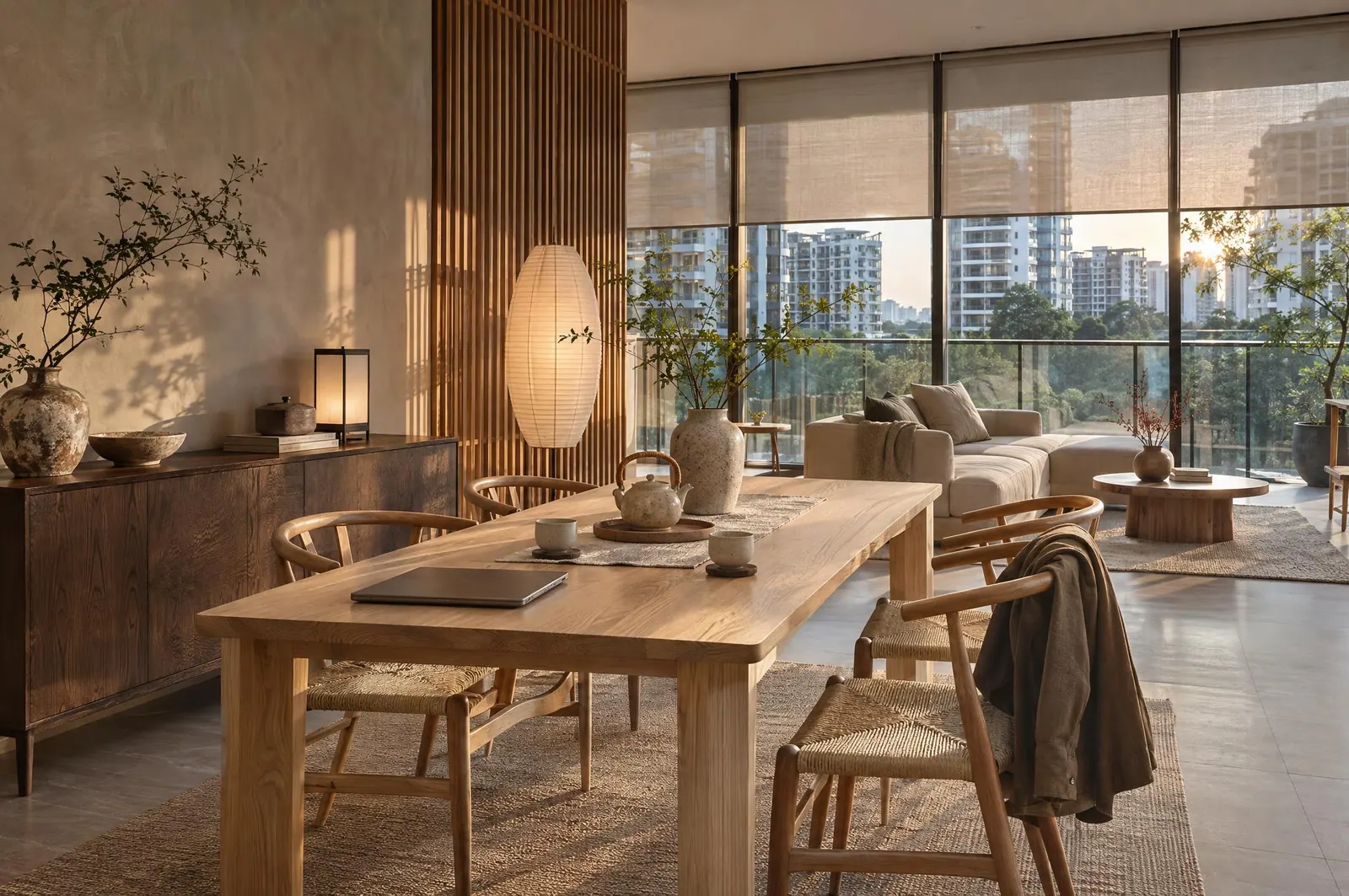
The detail most people miss is proportion. Japandi furniture sits lower than usual, so the wall above it reads as calm empty space. That emptiness is the design. It only works if everything else is hidden in full-height storage.
How does Japandi change in an HDB, condo or landed home?
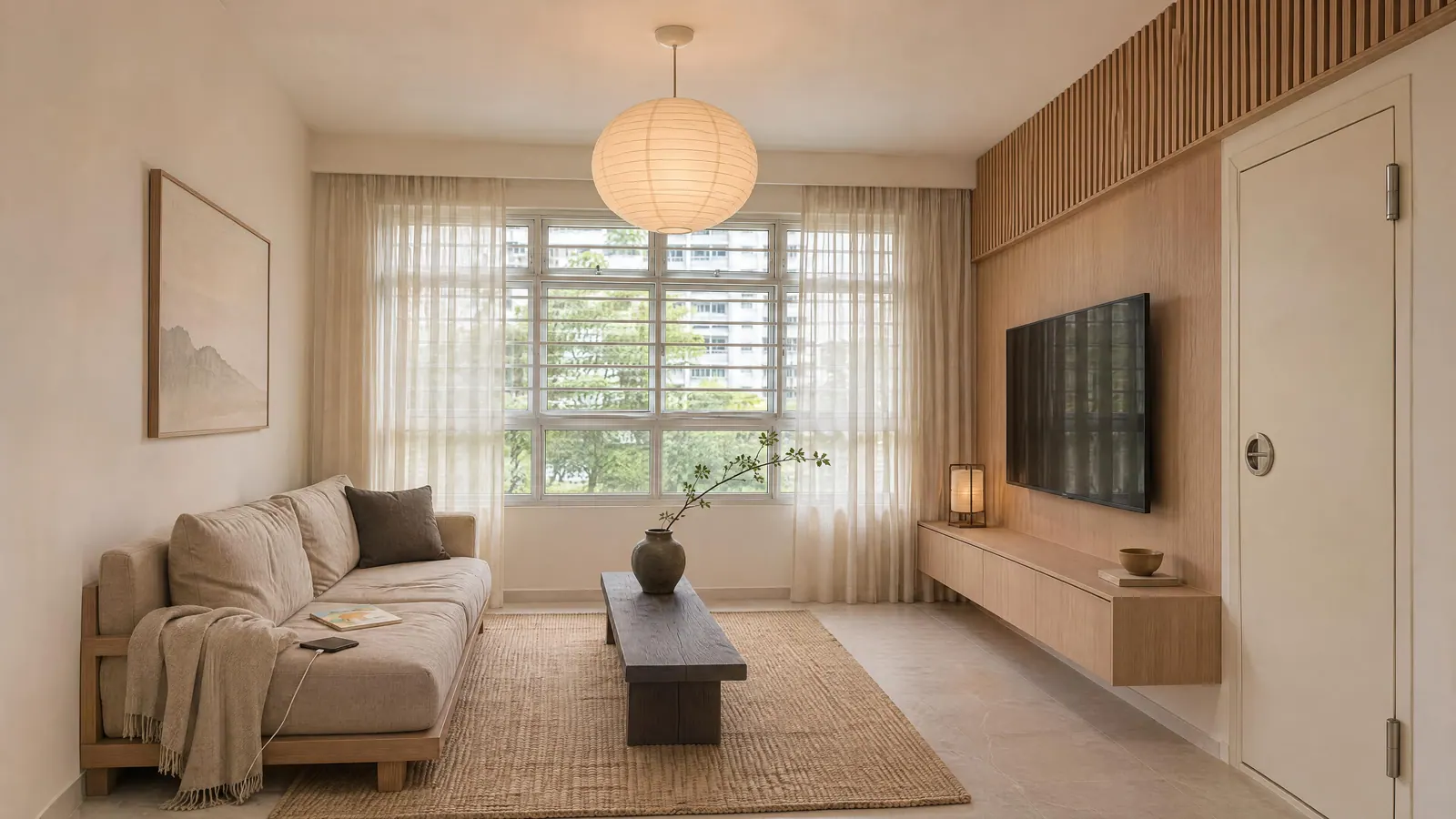
BTO flats. You start with a clean shell, so this is where Japandi is easiest. Plan the storage wall first: a floor-to-ceiling run of flush doors in the same veneer as the TV wall reads as one quiet surface. Paint the household shelter door the wall colour. Box the aircon trunking into a slim slatted bulkhead so it looks intentional.
Resale HDB. Older flats often have strong existing tiles. If the floor stays, pick a timber tone that sits with it rather than fighting it. Old window grilles can be painted to match the frames. Hacking, floors and bathroom finishes have HDB rules, so check the permit rules before you design around them.
Condo. Floor-to-ceiling glass brings in strong afternoon light. Use linen sheers plus a blackout or roller blind, and as a precaution keep natural veneers out of hours of direct sun. Condos have more height in some units, which lets you use a full-height slatted screen.
Landed. More space means you can add the things a flat cannot hold: a genkan-style shoe step at the entrance, a reading nook under the stairs, a courtyard view framed by a timber screen. The risk is emptiness that feels cold, so add rugs, textiles and layered light.
Humidity, everywhere. Singapore has high humidity all year; the Meteorological Service Singapore puts mean annual relative humidity at around 82%. Solid timber moves. Engineered wood, with its plywood core, copes better with humidity-related warping (SmartCalculator), and good vinyl is waterproof. Leave ventilation gaps behind wardrobes on external walls.
What mistakes make Japandi look generic?
- Five wood tones. One main timber, one contrast. Everything else is plaster, linen or stone.
- Open shelves everywhere. Japandi needs hidden storage. Open shelving in Singapore also collects dust fast.
- Cool-white downlights in a grid. They flatten the textures. Use warm light and fewer, better-placed fittings.
- All beige, no shadow. A charcoal frame, a dark-stained bench or a black tap gives the eye a full stop.
- Buying "Japandi" décor as a set. Pampas grass and ribbed vases do not make the style. Material and proportion do.
Sample room-by-room spec
Living: Light oak veneer TV wall with a floating console, slatted bulkhead for aircon trunking, stone-look vinyl plank or large matte porcelain floor, low sofa in oatmeal linen, paper pendant, one ceramic piece in a lit niche.
Kitchen: Flush handle-less cabinets in warm white with an oak-veneer tall unit, matte quartz top in a pale warm grey, small-format handmade-look backsplash tile, warm under-cabinet LED strip. Keep the appliance garage closed.
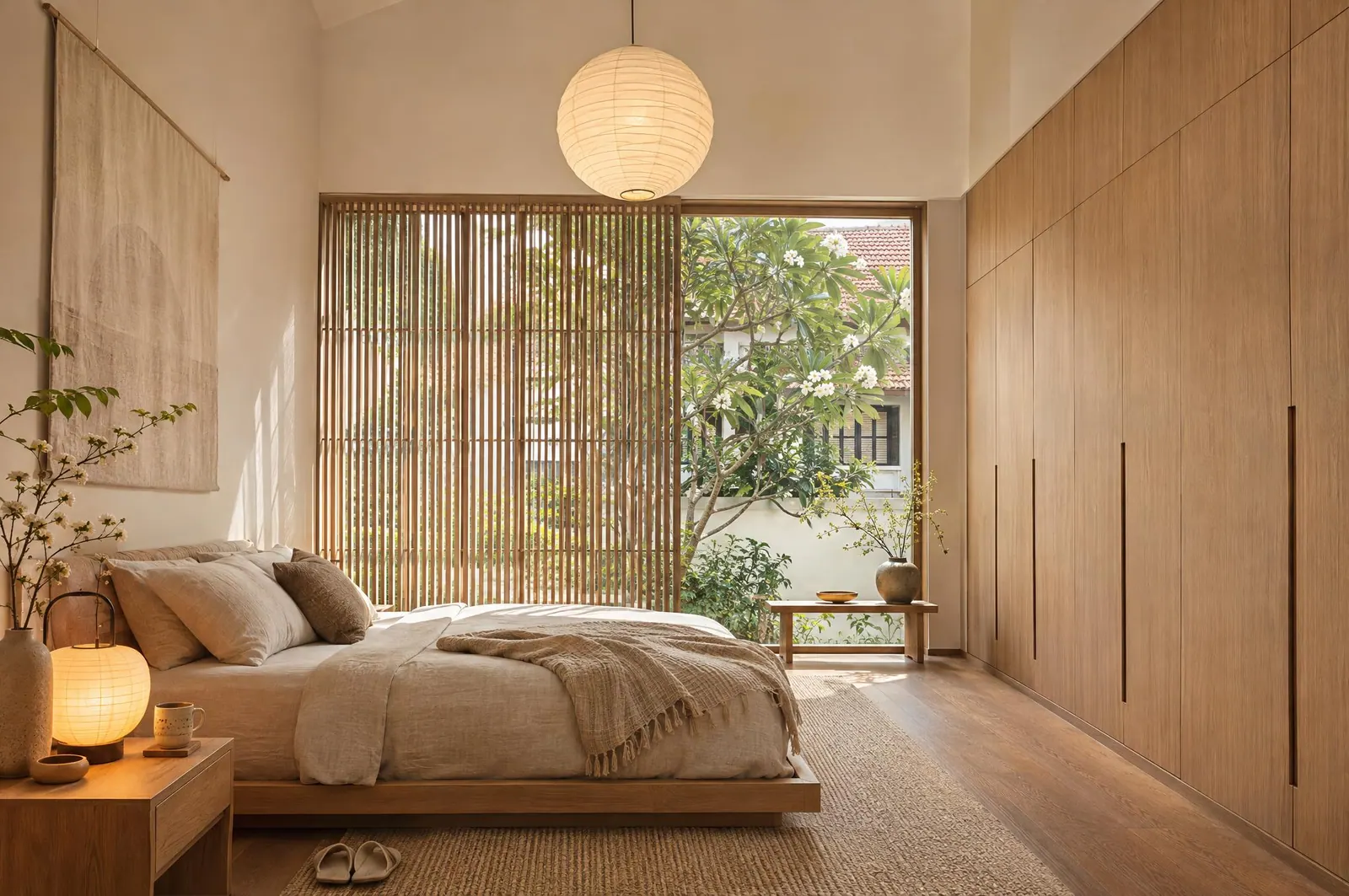
Bedroom: Low platform bed, full-height wardrobe with finger-pull grooves, linen curtains on a ceiling track, two wall lamps instead of bedside table lamps to free surfaces.
Bathroom: Warm grey stone-look tiles, oak-look vanity in moisture-resistant material (not real veneer near the shower), matte black or brushed fittings, a timber-look slatted stool. On a new BTO, plan around the existing finishes for the first three years (see FAQ).
Storage plan: Count what you own first: shoes, luggage, a vacuum, the rice cooker. Japandi only works when every item has a closed home.
How much does a Japandi renovation cost in Singapore?
There is no "Japandi price". Cost follows flat type and scope. Qanvast's 2026 estimates, based on 2025 medians:
| Home | Estimated renovation cost 2026 |
|---|---|
| 3-room BTO | $40,800 to $52,500 |
| 4-room BTO | $50,000 to $60,000 |
| 5-room BTO | $60,600 to $76,500 |
| 4-room resale | $70,000 to $81,600 |
| New condo | $44,290 to $62,160 (projection) |
| Resale condo | $78,280 to $105,000 (projection) |
Where Japandi moves the number: veneer instead of laminate. SmartCalculator puts laminate wardrobes at $200 to $320 per foot run and wood veneer at about 1.3 times laminate. Engineered wood flooring is listed at $10 to $18 per sq ft, vinyl/SPC at $4 to $10. We found no reliable published range for landed renovation, so we do not quote one.
See it in real designs: a Japandi HDB walk-through, a Modern Cream home room by room and all 13 styles in our interior design gallery.
Questions homeowners ask
Is Japandi suitable for HDB?
Yes. It is one of the best fits for HDB flats, because it relies on hidden storage and few objects, which makes small rooms feel larger. Plan full-height storage and hide the trunking.
How much does a Japandi BTO cost?
Qanvast estimates a 4-room BTO renovation at $50,000 to $60,000 in 2026, whatever the style. Japandi costs more within that if you choose veneer (about 1.3 times laminate per SmartCalculator) or real timber floors.
What is the difference between Japandi and Muji style?
Muji style is simpler and more uniform, mostly light wood and white. Japandi adds contrast (a darker timber or charcoal), more texture and more crafted pieces.
Can I use real wood flooring for Japandi in Singapore?
You can, but solid timber is sensitive to moisture. Engineered wood or a good vinyl plank gives the look with less movement.
Can I change the bathroom tiles in my new BTO for a Japandi look?
Not straight away. HDB's renovation guidelines set a 3-year restriction on removing bathroom and toilet wall and floor finishes in newly built flats. HDB's page does not say when the 3 years start; it is likely from the block's completion, so confirm with HDB for your flat. Until then, plan the bathroom look around fittings and overlays you are allowed to use.
Who can help me design a Japandi home in Singapore?
CAsarté Interior is a Singapore design-and-build firm for HDB, condo and landed homes. You get a fixed-price itemised quote, one project manager from design to handover, and a 1-year workmanship warranty. We're homeowners too, so we design for how you actually live. WhatsApp us at +65 8902 7516.
Try it on your own room
Not sure Japandi is you? Take the interior design style quiz. Then upload a photo of your room to Restyle and see it in Japandi, with your walls and windows kept as they are.
Sources
| URL | Title | Supports | Accessed |
|---|---|---|---|
| https://dac.dk/en/magazine/japan-and-scandinavia-found-each-other-long-before-we-learned-to-call-it-japandi | Japan and Scandinavia found each other long before we learned to call it Japandi (Danish Architecture Center) | Term emerged mid-2010s; Japonisme reached Denmark via Arnold Krog | 2026-11-18 |
| https://qanvast.com/sg/articles/what-are-the-expected-renovation-costs-for-hdb-flats-in-2026-3568 | What are the Expected Renovation Costs for HDB Flats in 2026? (Qanvast) | HDB cost ranges | 2026-11-18 |
| https://qanvast.com/sg/articles/singapore-condo-renovation-costs-new-and-resale-in-2026-3570 | Singapore Condo Renovation Costs (New and Resale) in 2026 (Qanvast) | Condo cost projections | 2026-11-18 |
| https://www.smartcalculator.sg/articles/carpentry-cost-singapore-2026 | Carpentry Cost Singapore (2026) (SmartCalculator) | Wardrobe per-foot-run rates, veneer multiplier | 2026-11-18 |
| https://www.smartcalculator.sg/articles/flooring-cost-singapore-2026 | Flooring Cost Singapore (2026) (SmartCalculator) | Flooring psf; engineered wood and humidity | 2026-11-18 |
| https://www.weather.gov.sg/climate-climate-of-singapore/ | Climate of Singapore (Meteorological Service Singapore) | High humidity all year; mean annual relative humidity around 82% | 2026-11-18 |
| https://www.hdb.gov.sg/managing-my-home/renovation-and-maintenance/renovation/renovation-guidelines/building-works | Building Works (HDB renovation guidelines) | 3-year restriction on removing bathroom and toilet wall and floor finishes in newly built flats | 2026-11-18 |