Wabi-sabi interior design in Singapore: a home that gets better with age
The quick answer
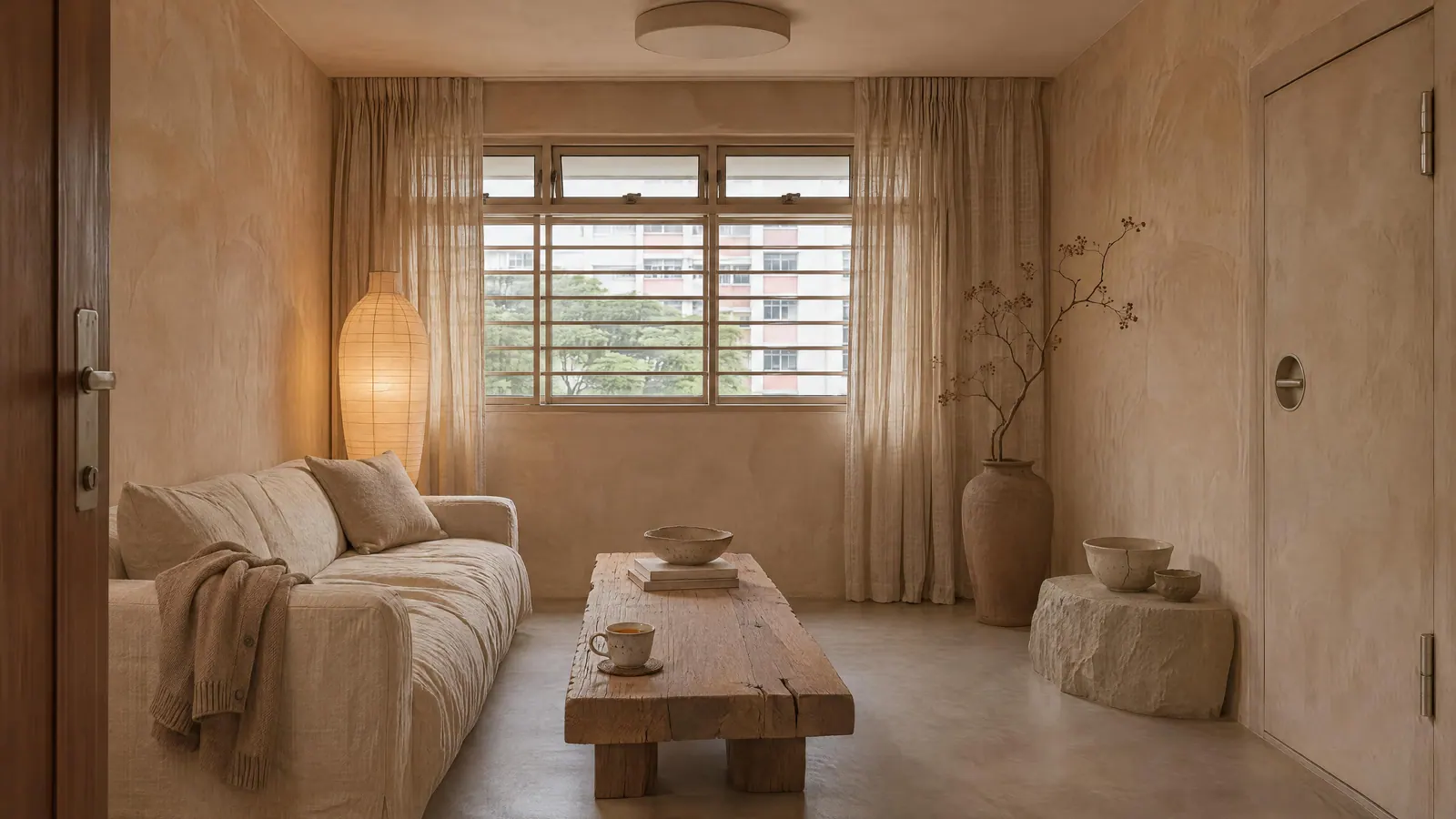
Wabi-sabi interiors favour quiet, imperfect and natural surfaces: limewash walls, raw timber, handmade ceramics, rumpled linen and soft, low light. In a Singapore HDB flat it brings real calm, but the materials need to handle humidity and daily cleaning. It need not cost more than a plain renovation; the money goes into a few honest materials rather than lots of carpentry.
Key points
- The look comes from texture, not decoration: plaster, timber grain, stone, linen.
- Leave space empty on purpose. Fewer, better objects.
- Limewash and microcement look right but need the right base and sealing.
- A wabi-sabi home can use less built-in carpentry than most styles.
- The generic version is "beige and dried pampas" with no real texture.
Where does wabi-sabi come from?
Wabi-sabi comes from Japanese aesthetics. Writing in The Conversation, Paul S. Atkins, a professor of Japanese, explains that "wabi" comes from a classical verb meaning to languish or be miserable, and that wabi-style tea emphasised "subtlety, frugality and restraint". He also notes that "wabi-sabi" as one combined term is largely a modern coinage that took off in English, and it does not appear in standard Japanese dictionaries.
So we treat wabi-sabi as a design attitude rather than a rulebook: honest materials, quiet surfaces, and accepting wear as part of the beauty.
What defines a wabi-sabi home?
| Element | What we specify |
|---|---|
| Palette | Clay, sand, stone grey, charcoal, undyed linen, muted olive |
| Materials | Limewash or mineral paint, microcement or plaster-look surfaces, rough-sawn or wire-brushed oak, stone, handmade tiles, linen, paper |
| Furniture | Low, simple, solid; a few vintage or handmade pieces |
| Signature details | Hand-trowelled walls, a raw stone plinth, one handmade ceramic, deep window sills used as seats |
| Lighting | Paper lamps, low wall lights, warm 2700K, very few downlights |
Design thinking: wabi-sabi needs shadow. A uniformly lit room flattens plaster and timber grain. We light walls from the side or below so the texture shows, and leave corners softly dim.
How does wabi-sabi change in an HDB, condo or landed home?
BTO. Limewash a single wall, not the whole flat, and let the rest be a warm mineral paint. Paint the shelter door to match. Keep carpentry minimal: one full-height closed run for storage, then loose furniture.
Resale HDB. This is where wabi-sabi is kindest to your budget. Older flats have quirks; this style embraces them. Keep sound old features (a terrazzo floor, a solid door) and build around them.
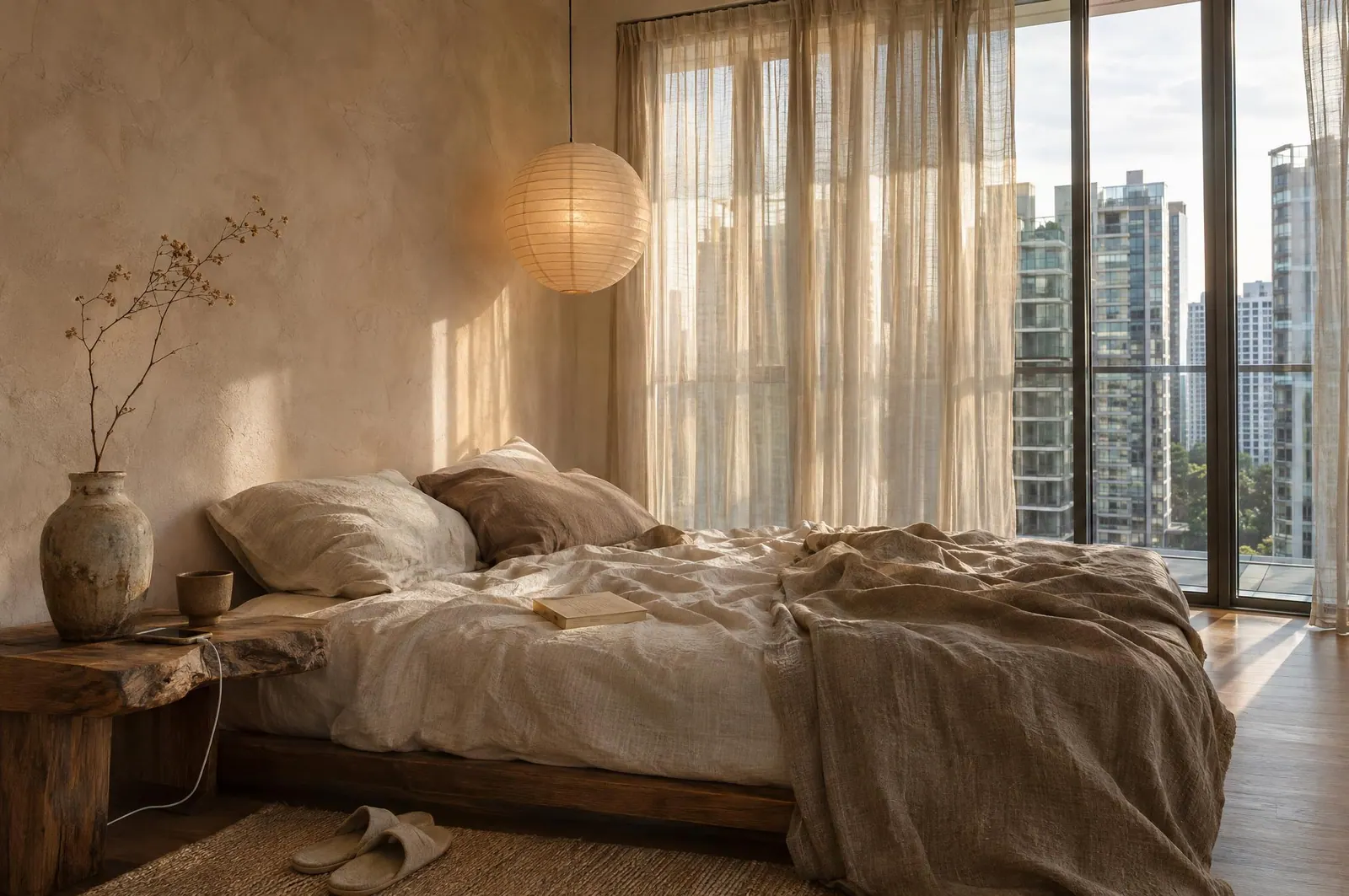
Condo. Floor-to-ceiling glass gives strong, even light that can flatten texture. Use linen sheers to diffuse it and lower lamps for the evening.
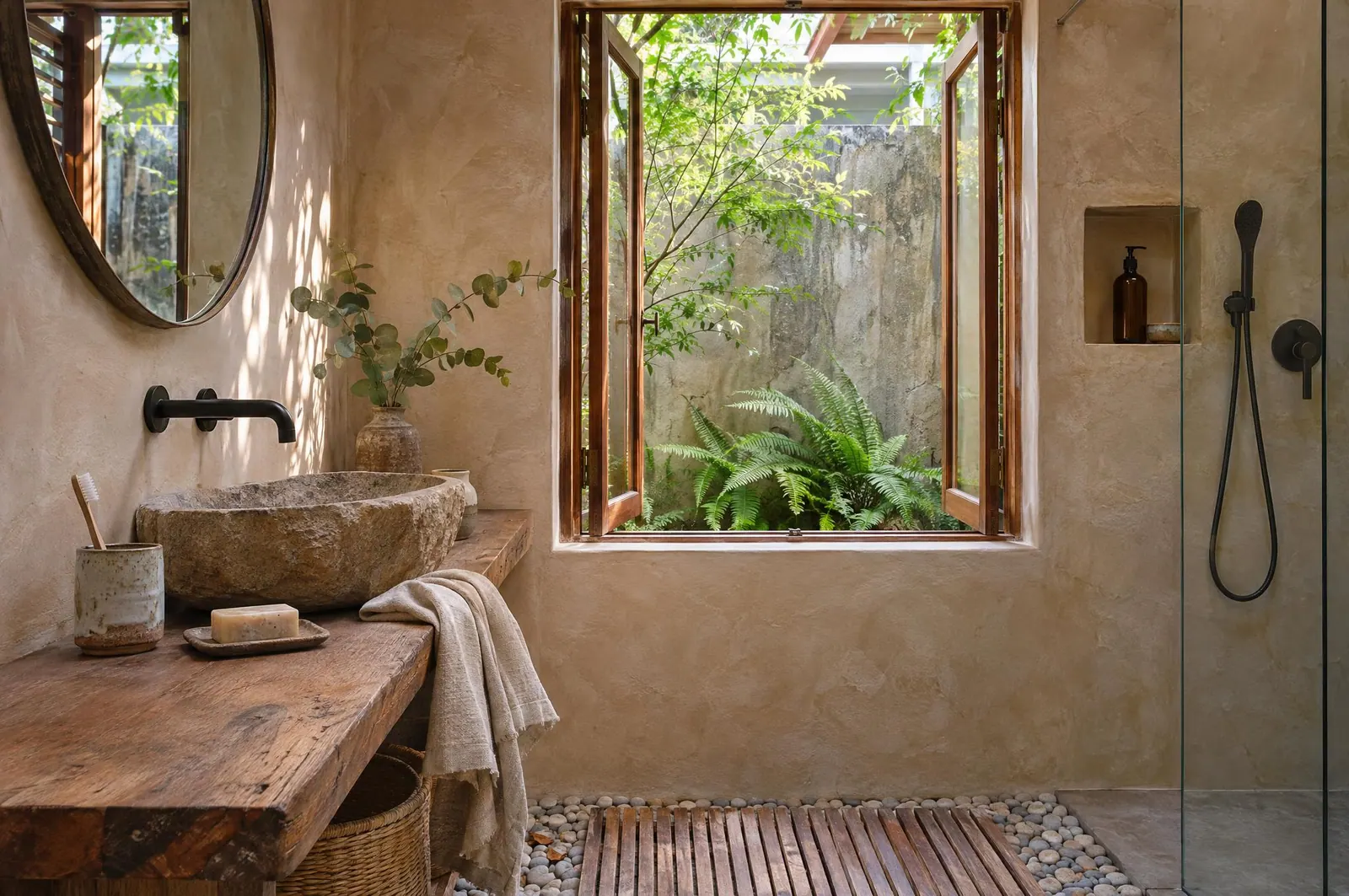
Landed. Courtyards, air wells and garden views are the natural partners of wabi-sabi. A bathroom open to a small planted courtyard is the classic move.
Humidity and finishes. Singapore's humidity is high all year (Meteorological Service Singapore). A soft, chalky limewash finish can mark where hands brush it, so we keep it on feature walls and ask for a sealed or washable limewash-look finish near switches and corridors. Qanvast puts microcement at typically 2 to 3 mm thick and notes that cracks in the base beneath can show through, so preparation matters more than the product. In a newly built flat, HDB's renovation guidelines set a 3-year restriction on removing bathroom and toilet wall and floor finishes (the period likely runs from the block's completion; confirm with HDB for your flat), so bathroom plaster looks may need to wait or use an overlay.
What mistakes make wabi-sabi look generic?
- Beige without texture. Flat paint and smooth laminate are not wabi-sabi. You need real surface.
- Dried pampas as the whole idea. Décor is the last 5 percent, not the style.
- Too many "rustic" props. One handmade bowl says more than ten.
- Bright, even downlights. They kill the shadow the style lives on.
- Faux distressing. Fake wear looks fake. Choose materials that age naturally instead.
Sample room-by-room spec
Living: One limewashed clay wall, mineral paint elsewhere, wire-brushed oak bench and shelf, low linen sofa, stone plinth with one ceramic, paper floor lamp, wall lights instead of a downlight grid.
Kitchen: Matte plaster-look or textured laminate cabinets, honed stone or concrete-look quartz top, handmade-look zellige-style tiles, open timber shelf for daily bowls only, warm under-cabinet light.
Bedroom: Low timber bed, flax linen bedding, limewashed headboard wall, one closed wardrobe in textured oak, paper pendant, linen curtains.
Bathroom: Plaster-look porcelain or microcement on walls (where rules allow), stone or concrete-look basin, matte black or aged brass tap, teak-look slatted mat.
Storage plan: Wabi-sabi only looks calm if daily clutter is out of sight. One deep closed run per room, then let the room breathe.
How much does a wabi-sabi renovation cost in Singapore?
Cost follows home type and scope. Qanvast's 2026 estimates (2025 medians): 3-room BTO $40,800 to $52,500; 4-room BTO $50,000 to $60,000; 3-room resale $55,000 to $68,300; 4-room resale $70,000 to $81,600; new condo $44,290 to $62,160; resale condo $78,280 to $105,000 (condo figures are projections).
Where wabi-sabi helps or adds:
| Choice | Effect |
|---|---|
| Less built-in carpentry | Carpentry is the biggest line in a typical 4-room budget, about 32% in SmartCalculator's example |
| Wood veneer instead of laminate | About 1.3 times laminate (SmartCalculator) |
| Vinyl/SPC floor | $4 to $10 per sq ft (SmartCalculator) |
Qanvast gives a rough guide for microcement of $175 to $250 per sqm (about $16 to $23 per sq ft). We did not find a reliable published price for limewash, so get both as itemised lines in your quote. We found no reliable published landed range either.
See it in real designs: a Japandi HDB walk-through, a Modern Cream home room by room and all 13 styles in our interior design gallery.
Questions homeowners ask
Is wabi-sabi suitable for HDB?
Yes, especially resale flats. It values calm and honest materials over expensive carpentry, which suits HDB budgets.
Does limewash work in Singapore's humidity?
It can, with care. A chalky limewash finish can mark where hands brush it, so we use it on feature walls rather than corridors and switch areas, and ask for a sealed or washable version where needed. Ask your painter what product and sealer they quote.
Does microcement crack in HDB flats?
It can. Qanvast notes cracks in the base beneath can show through the thin layer, so the substrate and installer matter most.
What is the difference between wabi-sabi and Japandi?
Japandi is cleaner and more refined, with smooth timber and flush joinery. Wabi-sabi is rougher and more textured, and accepts wear.
Can I do a wabi-sabi bathroom in a new BTO?
Partly. HDB's renovation guidelines set a 3-year restriction on removing bathroom and toilet wall and floor finishes in newly built flats; the period likely runs from the block's completion, so confirm with HDB. Plan the look with fittings, accessories and allowed overlays until then.
Who can help me design a wabi-sabi home in Singapore?
CAsarté Interior is a Singapore design-and-build firm for HDB, condo and landed homes. You get a fixed-price itemised quote, one project manager from design to handover, and a 1-year workmanship warranty. We're homeowners too. WhatsApp us at +65 8902 7516.
Try it on your own room
Take the interior design style quiz, then upload a photo to Restyle to see your room in wabi-sabi.
Sources
| URL | Title | Supports | Accessed |
|---|---|---|---|
| https://theconversation.com/what-is-the-japanese-wabi-sabi-aesthetic-actually-about-miserable-tea-and-loneliness-for-starters-220026 | What is the Japanese wabi-sabi aesthetic actually about? (Paul S. Atkins, The Conversation, 12 Mar 2024) | Origins of wabi; wabi tea; combined term a modern coinage not in standard Japanese dictionaries | 2026-11-18 |
| https://qanvast.com/sg/articles/what-is-microcement-a-complete-guide-for-singapore-homeowners-2693 | What Is Microcement? (Qanvast) | 2 to 3 mm thickness; substrate cracks show through; $175 to $250 per sqm rough guide | 2026-11-18 |
| https://www.hdb.gov.sg/managing-my-home/renovation-and-maintenance/renovation/renovation-guidelines/building-works | Building Works (HDB renovation guidelines) | 3-year restriction on removing bathroom and toilet wall and floor finishes in newly built flats | 2026-11-18 |
| https://qanvast.com/sg/articles/what-are-the-expected-renovation-costs-for-hdb-flats-in-2026-3568 | Expected Renovation Costs for HDB Flats in 2026 (Qanvast) | HDB ranges | 2026-11-18 |
| https://qanvast.com/sg/articles/singapore-condo-renovation-costs-new-and-resale-in-2026-3570 | Singapore Condo Renovation Costs 2026 (Qanvast) | Condo projections | 2026-11-18 |
| https://www.smartcalculator.sg/articles/hdb-renovation-cost-singapore-2026 | HDB Renovation Cost Singapore 2026 (SmartCalculator) | Carpentry about 32% of example budget | 2026-11-18 |
| https://www.smartcalculator.sg/articles/carpentry-cost-singapore-2026 | Carpentry Cost Singapore (2026) (SmartCalculator) | Veneer multiplier | 2026-11-18 |
| https://www.smartcalculator.sg/articles/flooring-cost-singapore-2026 | Flooring Cost Singapore (2026) (SmartCalculator) | Vinyl psf | 2026-11-18 |
| https://www.weather.gov.sg/climate-climate-of-singapore/ | Climate of Singapore (Meteorological Service Singapore) | High humidity | 2026-11-18 |